South Korea: A Vast, Sophisticated Market – Where the On-Ramp, Not the Law, Locks ATMs Out
Crypto is legal in South Korea, the market is one of the largest on earth, and the country runs one of the world's clearest digital-asset rulebooks. Yet for a crypto-ATM operator, South Korea is among the hardest markets anywhere — not because ATMs are banned, but because of how money is allowed to move. Every conversion between Korean won and crypto must pass through a verified, real-name bank account held at the same bank as a licensed exchange, and a walk-up cash deposit simply cannot satisfy that rule. Layered on top are tight limits on who may even open an account — foreigners and, until recently, companies have been shut out. A narrow path does exist: one operator, DarwinKS, runs a small, regulatory-sandbox-approved ATM network today — but it is foreigners-only, cash-out only, and capped at USD 2,000 per day, not the general-purpose cash-in/out model most operators would want. If you are weighing South Korea, the honest reading is this: the demand is enormous and the framework is maturing fast, but a mainstream ATM network is not viable under today's rules.
● Orange
|
16M
South Koreans holding crypto accounts — one of the highest rates worldwide
|
1 bank
Same real-name bank account required per exchange — no cash deposit
|
$2,000/day
Cap on Korea's only legal ATM network — foreigners only, cash-out only
|
Last updated: September 2026
A Clear but Uniquely Strict Framework
South Korea regulates crypto through two main pillars: the Act on Reporting and Use of Specific Financial Transaction Information (the AML Act) and the Act on the Protection of Virtual Asset Users (APVAU), in force since July 2024. Oversight is shared among the Financial Services Commission (FSC), the Financial Supervisory Service (FSS), the Korea Financial Intelligence Unit (KoFIU) and the Korea Internet & Security Agency (KISA).
Any virtual-asset service provider must register with authorities, obtain an Information Security Management System (ISMS) certification from KISA, segregate customer assets, hold the large majority of customer crypto (at least around 70%) in cold storage, and carry insurance or reserves against breaches. This is a fully built, rigorously enforced regime — the obstacle for an ATM business is not legal ambiguity but the structure of the rules themselves.[1][3]
The Real-Name Bank Account: Why a Cash ATM Doesn't Fit
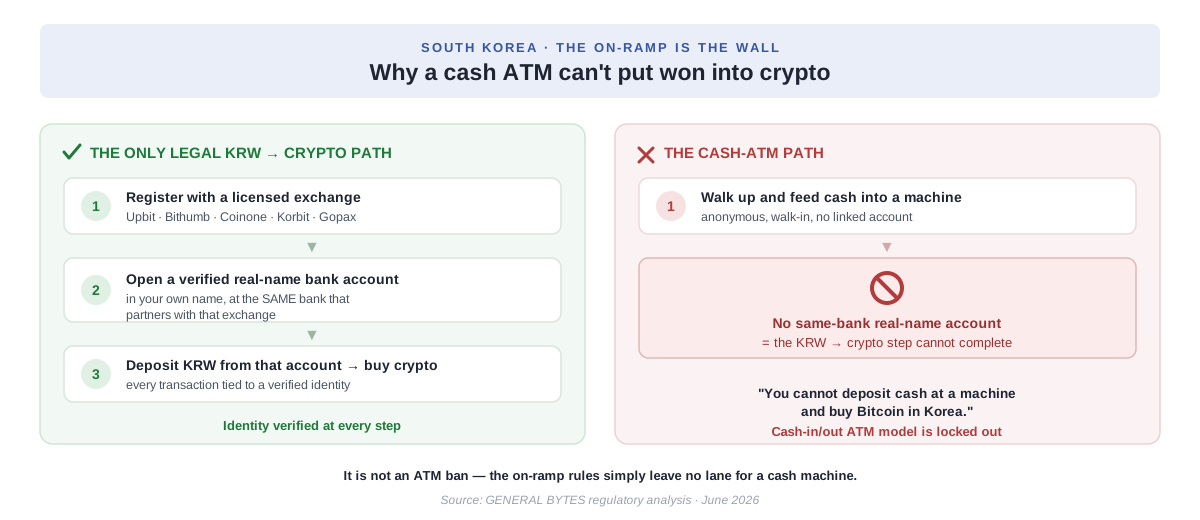
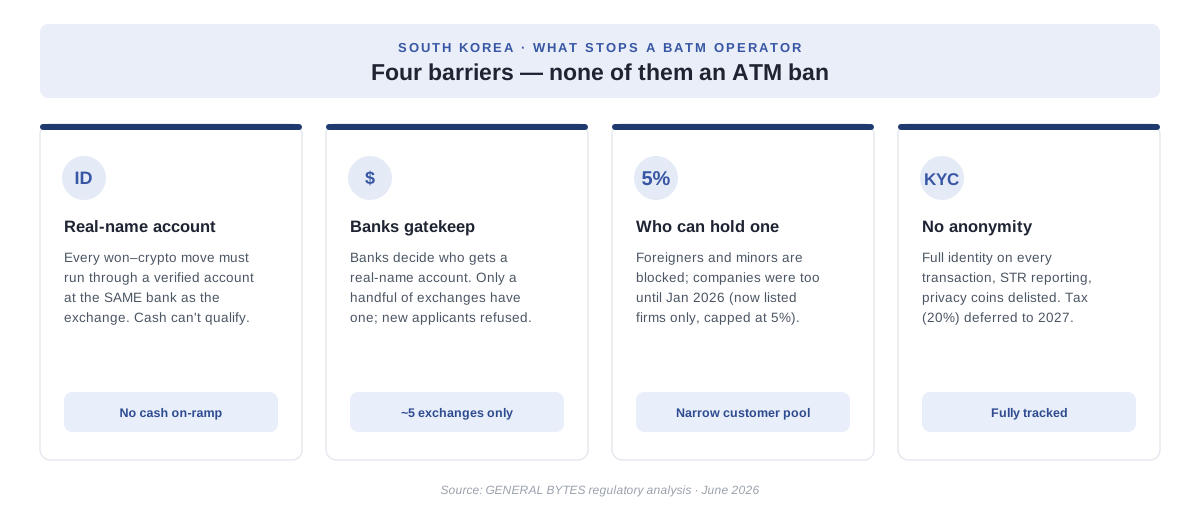
This is the decisive barrier. Under the AML Act, a VASP may move money between won and crypto only through a verified real-name bank account — meaning the customer must hold an account, in their own verified name, at the very same bank that partners with the exchange. Banks are not obliged to provide these accounts and exercise full discretion; in practice only a handful of the largest exchanges have secured them, and new applicants are routinely refused on AML-capability grounds. For an ATM, this is fatal to the standard model: a customer walking up and feeding cash into a machine cannot, by definition, route that transaction through a pre-existing same-bank real-name account. As one market guide puts it bluntly, you cannot deposit cash at a machine and buy Bitcoin in Korea. The on-ramp itself — not any ATM-specific prohibition — is the wall.[2][3]
A small number of Bitcoin ATMs do already operate in the country, but under a materially different model than a general cash-in kiosk. Since July 2024, the domestic operator DarwinKS has run Korea's only legally operating crypto-ATM network, built on a regulatory-sandbox ("innovative financial service") designation from the FSC rather than the real-name-account framework. Following a February 2025 partnership with retailer Homeplus, the network had grown to seven machines nationwide (six in Seoul, one in Busan) by May 2025.[12][13][14] The catch: these machines are foreigners-only — Korean nationals are barred under foreign-exchange rules — cash-OUT only (a user sends crypto online first and verifies by passport before withdrawing won in cash; there is no cash-deposit function), and capped at roughly USD 2,000 per person per day.[14] That confirms the pattern rather than contradicting it: a general-purpose, all-comers, cash-in/out ATM at meaningful scale still runs into the same-bank, real-name wall described above — but it also shows that a narrow, sandbox-approved, cash-out model is a proven, growing route for an operator willing to work within those limits.
Who Can Even Open an Account
The customer pool is narrowed further by who is allowed to participate. Since a December 2017 government announcement, exchanges have blocked minors and foreign nationals from opening trading accounts, and corporations were barred for years as well. That corporate ban is now lifting: in January 2026 the FSC finalised guidelines allowing listed companies and registered professional investors to allocate up to 5% of their equity to digital assets, with roughly 3,500 entities expected to gain access. But this opening is aimed at institutional balance-sheet investing through the major exchanges — not at retail cash transactions at a kiosk. For an operator, it is important context on the market's direction, but it does not create a route for an ATM network.[4][5]
AML, KYC and Tax
Anonymity is absent by design. Every fiat-to-crypto movement is tied to a verified identity, transactions are monitored, and banks must file suspicious-transaction reports — for example where a user moves more than KRW 10 million in a day or KRW 20 million in a week, or where a company transacts through accounts used for crypto. Privacy coins have been delisted from regulated exchanges. On tax, a capital-gains regime of 20% (22% including local surtax) on gains above a low annual threshold has been legislated but repeatedly postponed; the current effective date is 1 January 2027, with the first filings due in 2028 — and political pressure to scrap or further delay it continues. For an operator the takeaway is simple: assume full identity verification on every transaction, and treat the tax timeline as unsettled.[6][7]
The Market: Huge, Sophisticated — and Cooling
None of this is for lack of demand. Around 16 million South Koreans — roughly a third of all adults — hold crypto accounts, one of the highest participation rates in the world, and the won is among the most-traded fiat currencies in global crypto, accounting for a large share of worldwide fiat-to-crypto activity. Four to five licensed exchanges (Upbit, Bithumb, Coinone, Korbit and Gopax) handle the overwhelming majority of volume. The nuance for 2026 is that activity has cooled — won-denominated volumes fell sharply between late 2025 and early 2026, and South Koreans moved more than 160 trillion won (an estimated $110 billion) to offshore platforms during 2025 as users sought conditions the domestic rules do not offer.[11] The appetite is real; the regulated domestic channel is simply narrow.[3][8]
The Next 12–24 Months: Reform, but Not Yet for Cash Kiosks
South Korea is reforming actively — phased corporate access, work toward spot Bitcoin ETFs, a contested framework for won-denominated stablecoins, and a long-discussed Digital Asset Basic Law. But these initiatives target institutional and exchange channels; the one reform that would actually matter for an ATM business, easing the rigid "one exchange–one bank" real-name account model, is consistently described as a longer-term agenda item rather than an imminent change. For an operator, the realistic stance is therefore watch-and-wait: do not commit capital to a mainstream Korean deployment under today's rules, and instead monitor two specific triggers — any loosening of the same-bank real-name requirement, and any expansion of the sandbox route DarwinKS has used beyond a foreigners-only, cash-out-only model. If either moves, a market of this size and sophistication would reprice very quickly.[5][9]
How GENERAL BYTES Can Help
South Korea sits on our regulatory map precisely because it is a large prize behind a hard gate, and we track it so operators do not have to. GENERAL BYTES builds compliance-first BATM hardware and CAS management software with the controls a strict regime like Korea's would demand: full KYC and AML, Travel Rule support, customer-asset segregation and audit-ready reporting. If you are monitoring Korea for an opening — or evaluating which Asian markets are enterable today versus tomorrow — talk to us. We can help you compare jurisdictions on our legislation map and have machines ready to deploy the moment a market like this becomes workable.
Sources and references:
1. Lightspark: Is crypto legal in South Korea, 2. Lexology: Cryptoasset trading in South Korea, 3. TransNet: Korean crypto trading rules 2026, 4. Lexology: Cryptoasset trading in South Korea, 5. CoinGecko: South Korea crypto market 2026, 6. Financial Services Commission (FSC) press release, 7. Blockhead: Korea sets January 2027 for crypto tax, 8. BeInCrypto: Korea's pivotal crypto shift, 9. Tiger Research: Changes in the global crypto market after Korea's election, 10. Newhedge: Buying Bitcoin in South Korea, 11. CoinDesk: $110 billion in crypto left South Korea in 2025 owing to strict trading rules (citing a joint CoinGecko / Tiger Research report), 12. Electronic Times (etnews): Korea's first crypto ATM launches (DarwinKS, sandbox basis), 13. etnews: Homeplus × DarwinKS ATM network expansion, 14. Daum: Seven coin ATMs nationwide, foreigners-only, $2,000 daily cap (May 2025).
Legal Disclaimer: This article by GENERAL BYTES is for informational purposes only and does not constitute formal legal, financial, or investment advice. South Korea's digital-asset framework, tax timeline and banking rules continue to evolve; always consult specialised local legal counsel and confirm current FSC, FSS and KoFIU requirements before considering market entry.